Aligning Classroom Observations with District Rubrics: A Practical Guide for Principals
Aligning Classroom Observations with District Rubrics: A Practical Guide for Principals School principals face a persistent operational dilemma every academic year: bridging the gap between highlevel district evaluation rubrics and the live, dynamic reality of daily classroom practice. While distric

Aligning Classroom Observations with District Rubrics: A Practical Guide for Principals
School principals face a persistent operational dilemma every academic year: bridging the gap between high-level district evaluation rubrics and the live, dynamic reality of daily classroom practice. While district rubrics—often adapted from frameworks like the Danielson Group Framework for Teaching or the Marzano Teacher Evaluation Model—provide essential criteria for effective teaching, their language can feel abstract, subjective, and open to interpretation. When evaluators interpret these guidelines inconsistently, observations risk becoming compliance-driven exercises rather than engines for instructional growth.
To transform classroom observations into meaningful drivers of professional learning, school leaders must systematically align raw instructional evidence with specific rubric indicators. By moving from subjective impressions to low-inference scripting, establishing inter-rater reliability, and structuring feedback conferences around concrete data, principals can build an evaluation ecosystem rooted in fairness, clarity, and continuous improvement.
Deconstructing District Rubrics: Translating Abstract Standards into Observable Behaviors

Unpacking High-Level Rubric Indicators and Vague Evaluation Language
District evaluation frameworks frequently employ broad, qualitative descriptors such as "actively engaged," "rigorous instruction," "responsive pacing," or "positive classroom culture." While these phrases capture noble instructional ideals, they lack operational precision. Without clear definitions, two assistant principals observing the same classroom might reach wildly different conclusions—one viewing independent seatwork as "quiet focus" while the other categorizes it as "passive compliance."
To eliminate ambiguity, instructional leaders must unpack district evaluation language by asking three core questions during team calibration:
- What does this standard look like in action? (Physical artifacts, teacher prompts, student moves)
- What does this standard sound like? (Verbal questioning, student discussions, academic vocabulary)
- What evidence disproves the presence of this indicator? (Off-task behavior, rote recall, one-way lecture)
By systematically dissecting evaluation standards alongside administrative teams and department heads, principals establish shared operational definitions for every performance level.
Defining Concrete Teacher Actions vs. Observable Student Behaviors
A foundational error in classroom observation is focusing exclusively on what the teacher is doing while ignoring student cognitive work. Highly effective observation practices parse evidence into two distinct, codependent categories: teacher inputs and student outputs.
- Teacher Actions: Specific instructional choices, questioning strategies, time management, and differentiation techniques. For instance, rather than noting "Teacher managed transitions well," record "Teacher provided a visual timer set to 60 seconds and gave a clear two-step verbal instruction."
- Observable Student Behaviors: Measurable student responses, engagement indicators, peer interactions, and academic outputs. Instead of writing "Students understood the lesson," record "22 out of 24 students completed the formative exit ticket independently within 4 minutes."
Separating these elements ensures that ratings reflect genuine student learning outcomes rather than persuasive teacher performances. Research synthesized by John Hattie’s Visible Learning highlights that evaluating student learning progress—rather than teacher behavior alone—yields the highest impact on school achievement.
Building a School-Wide Rubric Deconstruction Matrix for Instructional Clarity
To ensure whole-school alignment, principals should lead staff in creating a Rubric Deconstruction Matrix. This tool maps broad district rubric indicators directly to concrete classroom evidence across subjects and grade levels.
| District Rubric Indicator | Vague / Subjective Interpretation | Concrete Teacher Action | Observable Student Behavior |
|---|---|---|---|
| Higher-Order Questioning | "Teacher asked good, challenging questions." | Poses open-ended prompt: "Why did the author choose path A over path B? Cite two text details." | 85% of students reference text evidence during turn-and-talk discussions. |
| Active Student Engagement | "Class was very engaged in the activity." | Circulates with a check-for-understanding clipboard during partner work. | Students actively annotate reading passages and orally defend answers using target vocabulary. |
| Differentiated Instruction | "Teacher catered to different learning styles." | Provides tiered graphic organizers based on pre-assessment data. | Students utilize assigned scaffolds independently to complete multi-step problem sets. |
Scripting Objective Evidence: Moving from Impression to Impactful Fact

The Mechanics of Low-Inference Scripting During Classroom Walkthroughs
Low-inference scripting is the practice of recording verbatim dialogue, precise timestamps, physical movements, and quantitative tallies without assigning immediate judgment. Evaluators act as neutral reporters rather than instant critics.
Key mechanics of effective low-inference scripting include:
- Verbatim Scripting: Capturing exact teacher prompts and student responses (e.g., T: "What is step two?" S1: "Multiply by x.").
- Time-Sampling: Annotating observations with precise timestamps every 2–3 minutes to monitor pacing and instructional transitions.
- Quantitative Data Collection: Counting cold calls versus hand-raises, recording wait time in seconds, or tracking teacher movement across classroom zones.
Eliminating Subjective Bias and Qualitative Impressions from Observation Notes
Subjective language undermines trust between teachers and administrators. Words like hasty, disorganized, energetic, warm, or weak reflect evaluator bias rather than objective reality. When feedback relies on impressions, post-observation debriefs frequently devolve into defensive debates over perception.
To eliminate bias, evaluators must audit their notes in real-time, removing adjectives and replacing them with empirical data:
- High-Inference (Biased): "Teacher lost control of the classroom during group work."
- Low-Inference (Objective): "At 10:14 AM, 6 of 20 students were speaking about non-instructional topics while teacher worked with Group 1."
- High-Inference (Biased): "Excellent wait time after asking questions."
- Low-Inference (Objective): "Teacher paused for 5.2 seconds after posing an open-ended question before calling on a student."
Side-by-Side Comparison: Raw Scripted Notes vs. Rubric-Aligned Level Ratings
Transforming raw evidence into accurate rubric ratings requires a systematic synthesis step. Evaluators should cross-reference empirical notes directly with rubric performance tiers.
| Raw Scripted Observation Notes | Biased / Weak Synthesis | Rubric Domain Alignment | Justified Rating & Level |
|---|---|---|---|
| 10:02 AM: T says, "Solve #3." Waits 2 sec. Calls on S1. S1 says "12". T says "Good." T moves to #4. | "Teacher didn't give enough time and questioning was superficial." | Domain 3: Instruction (Questioning & Discussion Techniques) | Developing: Questioning relies on low-level recall; wait time averaged under 2 seconds; no student-to-student discourse observed. |
| 10:15 AM: T asks, "How does the author construct argument X?" T pauses 6 sec. 8 hands raise. T calls on S2. S2 responds. T prompts: "Who can build on S2's point?" S3 responds directly to S2. | "Teacher demonstrated strong instructional techniques." | Domain 3: Instruction (Questioning & Discussion Techniques) | Proficient / Distinguished: High-cognitive questions, adequate wait time (6 sec), and structured student-led discussion routines. |
Establishing Inter-Rater Reliability Across Your Leadership Team

Structuring Effective Calibration Sessions and Joint Observation Walkthroughs
Inter-rater reliability (IRR) ensures that a teacher receives the exact same evaluation rating regardless of which administrator steps into their classroom. Without regular calibration, evaluators develop personal "scoring drift," leading to skewed building data and perceptions of unfairness.
To build IRR, principals should implement monthly calibration sessions structured around the following framework:
- Video Analysis: Leadership teams watch an unedited 15-minute classroom video segment together while scripting independently.
- Independent Scoring: Each administrator assigns domain ratings using only their scripted evidence.
- Debrief & Defense: Evaluators compare ratings, forcing each team member to justify scores using explicit quotes and timestamps from their scripts.
Standardizing Rating Criteria to Eliminate Scoring Discrepancies Between Evaluators
Scoring discrepancies typically emerge when administrators apply differing thresholds for performance levels. One evaluator might demand 100% student mastery for a "Distinguished" rating, while another awards it for creative lesson design.
To standardize scoring criteria across evaluators:
- Establish Anchor Videos: Maintain a secure building library of calibrated observation exemplars representing each rubric level across grade levels.
- Adopt the "Evidence-First Rule": Require evaluators to highlight physical script evidence before checking a rubric box. If evidence cannot be pointed to in the notes, it cannot factor into the rating.
- Calculate Percentage Agreement: Track evaluator agreement rates during joint walkthroughs. Aim for at least 85% scoring alignment across all administrative team members.
Protocols for Maintaining Building-Wide Evaluation Consistency Across the School Year
Consistency is not a one-time workshop; it requires continuous organizational protocols. According to insights from EdResearch for Action, high-quality teacher evaluation systems depend heavily on continuous observer training and consistent scoring routines throughout the academic year.
- Quarterly Co-Observations: Pair principals, vice principals, and instructional coaches to conduct simultaneous 20-minute walkthroughs, debriefing immediately afterward.
- Mid-Year Audit: Review all completed observation reports across the school to check for score inflation or disproportionate distribution of ratings.
- Norming Refresher Workshops: Revisit rubric standards at the start of each semester, specifically targeting domains with high subjective variability, such as classroom environment and student assessment integration.
Delivering Rubric-Aligned Feedback and Structuring Post-Observation Conferences

Linking Factual Evidence to Specific Rubric Domains and Actionable Coaching Steps
Observation feedback often fails when it is overly general (e.g., "Great job today!") or excessively punitive. Effective feedback bridges the gap between observed facts, rubric criteria, and immediate next steps.
High-impact feedback follows a three-part structure:
- The Observed Reality (Fact): "During the 15-minute group task, 4 out of 5 groups requested teacher assistance to understand directions."
- The Rubric Standard (Domain): "District Rubric Indicator 2c requires clear instructions that allow students to proceed independently."
- The Actionable Coaching Step (Growth): "Next lesson, model the task visually on the board and check for understanding by asking 2 students to repeat the instructions back before launching group work."
A Structured 4-Step Template for Productive Post-Observation Dialogue
Post-observation conferences should be collaborative coaching conversations rather than top-down evaluations. Utilizing a consistent 4-step framework puts the teacher at the center of reflection:
- Step 1: Teacher Self-Reflection (5 mins)
Prompt: "Looking at your lesson objectives, how well did student output match your expectations? What evidence supports that?" - Step 2: Reviewing Scripted Data (10 mins)
Action: Share the raw low-inference script. Walk through timestamped evidence together to establish a shared baseline of facts. - Step 3: Co-Analyzing Rubric Alignment (10 mins)
Prompt: "Based on our scripted notes regarding student questioning, which descriptor under Domain 3 best reflects this lesson?" - Step 4: Defining One High-Leverage Action Step (5 mins)
Action: Agree upon one precise, measurable teaching move to implement within the next 48 hours, complete with a follow-up walkthrough date.
Navigating Difficult Conversations and Effectively Addressing Teacher Pushback
When observation ratings fall below teacher expectations, pushback is natural. Administrators can de-escalate tension by adhering to proven dialogue strategies:
- Anchor in Data, Not Opinions: When a teacher states, "You just happened to walk in during the worst 5 minutes," respond neutrally with data: "Let me share the exact script from that 15-minute segment so we can look at the student engagement patterns together."
- Separate Intent from Impact: Acknowledge good intentions while highlighting outcome: "I know your intent was to let students explore freely, but the evidence shows 60% of students were off-task due to unclear guidelines."
- Focus on Growth Over Penalties: Frame low ratings as opportunities for targeted coaching, mentoring, and resource allocation.
Streamlining Evaluation Workflows with EdTech and Practical Checklists

Leveraging Digital Observation Tools for Automated Indicator Categorization
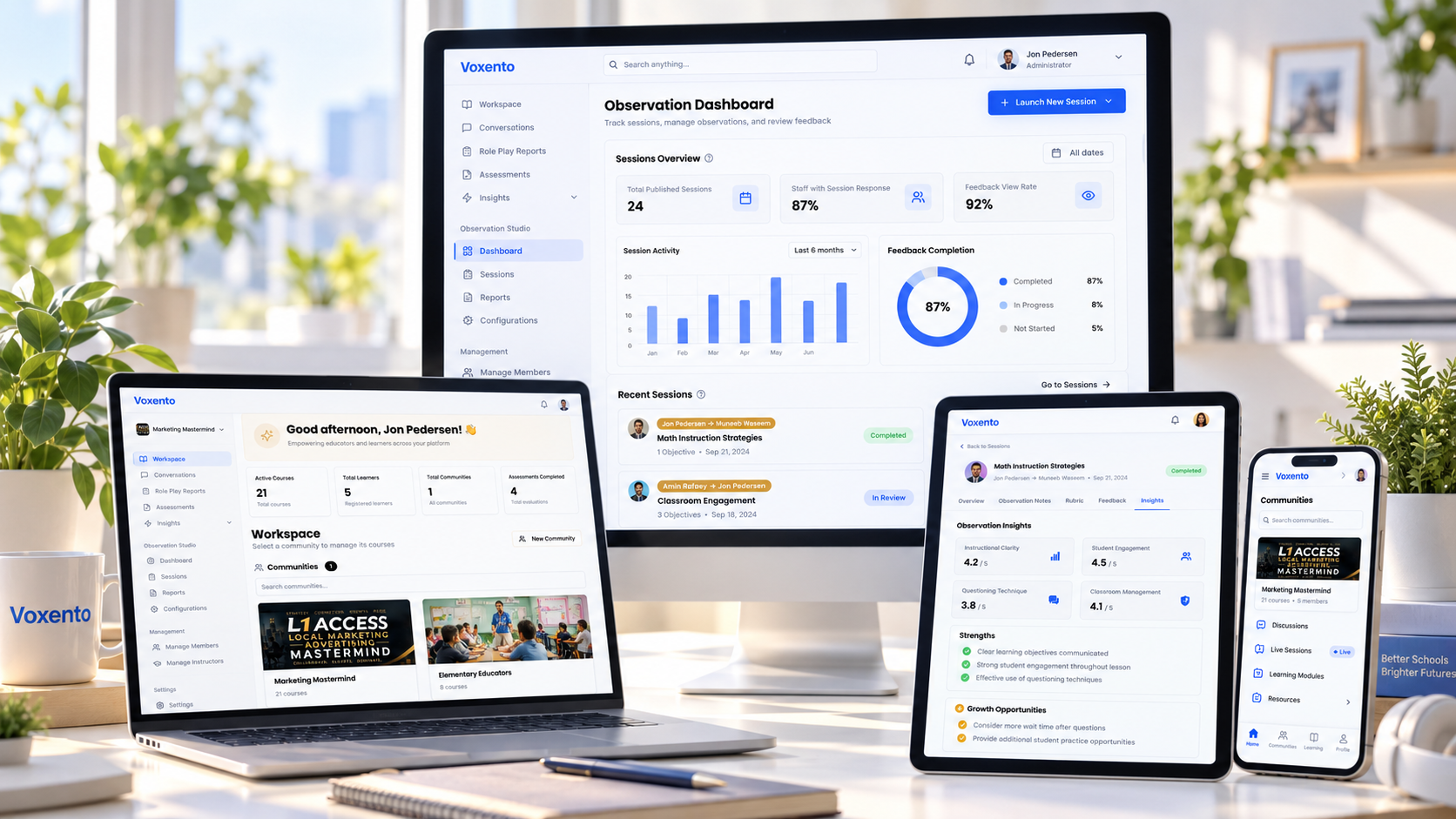
Modern educational technology platforms—such as KickUp, TeachBoost, Vector Evaluations, and EdReflect—have revolutionized evaluation workflows. These tools allow principals to tag low-inference notes directly to district rubric standards during walkthroughs using custom keyboard shortcuts or drop-down tags.
Benefits of integrating digital evaluation tools include:
- Instant Tagging: Map scripted dialogue to specific rubric sub-domains in real time.
- Automated Trend Analytics: Identify school-wide instructional gaps across subjects and grade bands instantly.
- Streamlined Communication: Send formatted, objective observation reports to teachers within 24 to 48 hours of a classroom visit.
The Principal’s Step-by-Step Observation Alignment and Calibration Checklist
To maintain operational fidelity, principals can follow this practical checklist throughout every observation cycle:
Phase 1: Pre-Observation & Setup
- Review teacher’s previous observation feedback and professional growth goals.
- Confirm district rubric domain focus areas for the walkthrough.
- Prepare low-inference scripting tool (digital platform or split-page template).
Phase 2: In-Classroom Observation
- Record exact timestamps for lesson transitions and key instructional segments.
- Script verbatim teacher prompts and student responses.
- Tally student engagement rates, wait time, and question depth (DOK levels).
- Avoid recording subjective adjectives or immediate emotional reactions.
Phase 3: Post-Observation Analysis & Synthesis
- Audit scripted notes to strip out remaining qualitative bias.
- Cross-reference objective evidence against district rubric performance indicators.
- Formulate one specific, high-leverage action step focused on student learning.
- Conduct post-observation dialogue within 3–5 school days using the 4-step conference template.
Utilizing Aggregate Rubric Data to Drive Targeted School-Wide Professional Development
Classroom observations yield rich datasets that extend far beyond individual teacher ratings. To maximize systemic impact, school leaders should use aggregate data to plan evidence-based professional growth initiatives.
If aggregate data indicates that 65% of teachers score "Developing" in Domain 3b: Questioning Techniques, the principal should not rely on isolated individual coaching. Instead, leadership can align school-wide professional learning communities (PLCs), professional development workshops, and peer observation schedules around higher-order questioning frameworks. Transforming evaluation metrics into collective learning targets creates a continuous cycle of instructional excellence.
Conclusion
Aligning classroom observations with district rubrics is far more than a compliance obligation—it is a vital leverage point for school transformation. When principals deconstruct vague evaluation criteria, script objective low-inference data, cultivate inter-rater reliability, and lead collaborative post-observation conferences, they turn rubrics from intimidating scorecards into empowering roadmaps for growth. By pairing rigorous observational discipline with modern digital tools, school leaders foster a culture of professional trust, elevated pedagogy, and superior student achievement across every classroom.



Next step
Need help applying this pattern?
Bring the bottleneck and the stack. We will map the first implementation path.