Cloud, DevOps, and support

Keep production software working after launch.

Stabilize deployments, monitoring, performance, maintenance, and support paths before small production issues become customer problems.

See delivery proof
Support proof

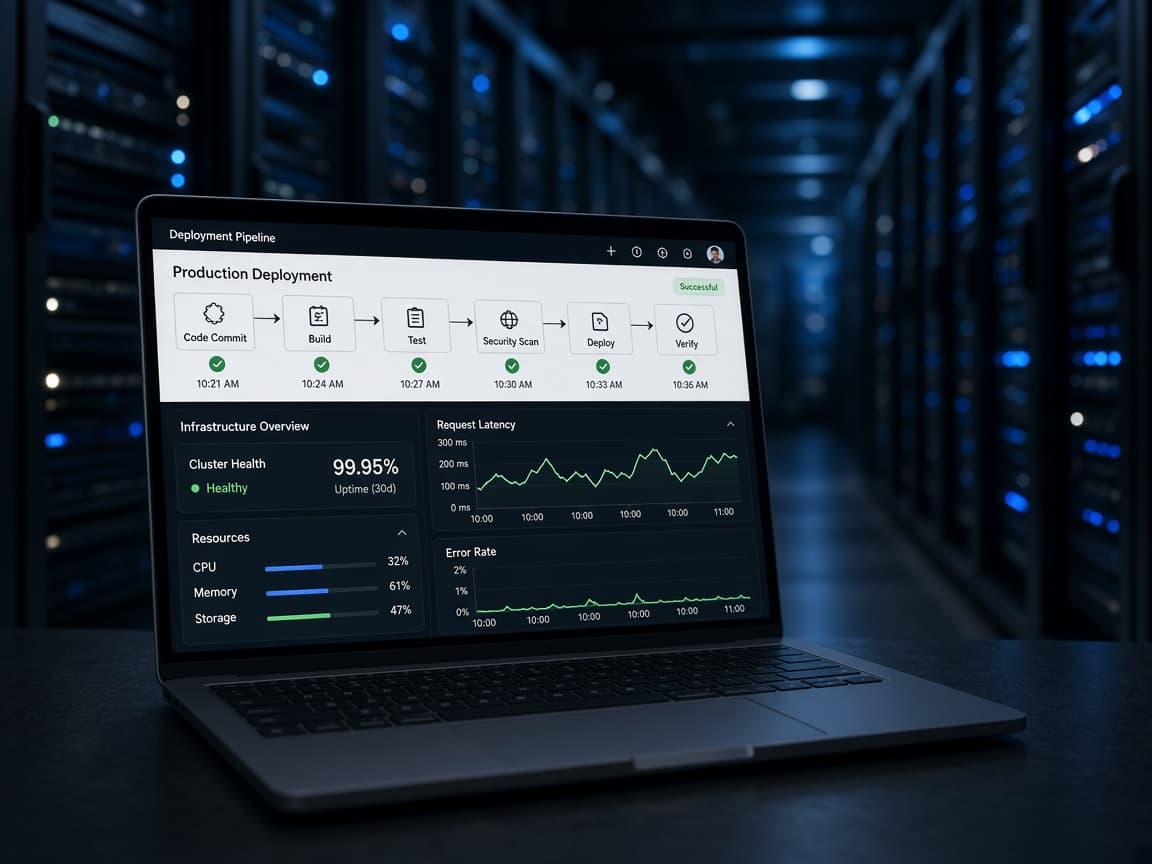
Production SaaS, portal, commerce, and integration systems stabilized around monitoring and release control.

View delivery proof
Outcome
A product your team can operate with less panic
Mechanism
Deployments, monitoring, maintenance, and support
Risk reducer
Failures, releases, and ownership made visible
CI/CD
Cleaner releases
Monitoring
Earlier issue signals
Performance
Faster user experience
Support
Post-launch ownership
Strategy call

Leave with the first move mapped.

The call is useful even if we do not build together. We use it to clarify what should happen next, what can wait, and what could make the project expensive.

Scope map
Users, systems, first release
Risk list
Unknowns to resolve early
Build path
Milestones and ownership
Range
Timeline and budget signals
Free checklist

Production Support Readiness Checklist

Check deployment, monitoring, backups, alerts, access, and support ownership before production issues compound.

  • Deployments
  • Monitoring
  • Ownership
Open support checklist
Problems and use cases

Built for teams where launch is not the finish line.

DevOps and support matter when the product is already useful enough that downtime, slow releases, weak monitoring, or unclear ownership creates real business risk.

Deployment

Releases are manual and stressful

Builds, environment variables, migrations, and rollback decisions need a clearer path.

Monitoring

Issues are found by users first

Logs, alerts, uptime checks, error tracking, and performance signals need to be visible.

Performance

The product feels slow

Core user flows, pages, APIs, images, scripts, and database calls need review and improvement.

Maintenance

Dependencies and hosting are drifting

Framework, package, hosting, security, and version updates need planned upkeep.

Support

No one owns post-launch fixes

Bug triage, production incidents, small enhancements, and stakeholder communication need a support lane.

Scale

The system is outgrowing its first setup

Cloud, database, queue, cache, storage, and deployment choices need a more durable foundation.

Desired transformation

Move from fragile launch to a system with operating discipline.

The outcome is a production environment with clearer release paths, better visibility, fewer preventable issues, and support expectations that the business can rely on.

01

Cleaner deployments

02

Better incident visibility

03

Faster pages and APIs

04

Maintenance roadmap

05

Clear support ownership

Service offer

A cloud, DevOps, and support lane for production systems.

The engagement can include deployment setup, CI/CD, hosting review, environment configuration, monitoring, performance review, security basics, documentation, maintenance, and support.

Scoped offer

Support should make ownership clearer.

We focus on the release and monitoring details that help a product stay usable after the initial build is done.

01

Audit

Review environments, release flow, risks, and current pain.

View phase checklist
  • Hosting
  • Deployments
  • Logs
  • Dependencies
02

Stabilize

Fix the highest-risk production and release issues.

View phase checklist
  • CI/CD
  • Env config
  • Monitoring
  • Backups
03

Optimize

Improve performance, reliability, and maintainability.

View phase checklist
  • Core flows
  • API speed
  • Image/script review
  • Database checks
04

Support

Create a practical operating path after launch.

View phase checklist
  • Triage
  • Maintenance
  • Documentation
  • Roadmap
Capabilities

Production capabilities that reduce operational risk.

Cloud and support work should be scoped around the product's real failure modes and release rhythm.

Deployment and CI/CD

Cleaner path from code to production.

View capabilities
  • Build pipelines
  • Environment variables
  • Preview deploys
  • Rollback planning

Monitoring and reliability

Visibility into issues before they become expensive.

View capabilities
  • Logs
  • Alerts
  • Uptime
  • Error tracking

Performance and security basics

Practical improvements to user and system quality.

View capabilities
  • Core Web Vitals
  • API latency
  • Dependency review
  • Access review

Maintenance and support

Ongoing support for product systems.

View capabilities
  • Bug triage
  • Updates
  • Documentation
  • Release planning
Support types

Where cloud and support work usually helps.

The work can be a focused stabilization sprint, a launch-readiness pass, or ongoing support after a build.

01

Launch readiness

Deployment, env config, QA, monitoring, and handover before production.

02

Stabilization sprints

Fix slow, fragile, or unreliable production behavior after launch.

03

CI/CD setup

Build, test, preview, and release workflows for modern web apps and APIs.

04

Performance improvement

Frontend, backend, image, API, and database review for speed.

05

Ongoing support

Maintenance, bug triage, updates, and future release planning.

Process

A support process that starts with production risk.

The process identifies what can break, where visibility is weak, and which release or maintenance habits need cleanup.

01

Fit and workflow discovery

We clarify the users, business workflow, systems, constraints, and success criteria before recommending a build path.

02

Roadmap and architecture

The first release, integration boundaries, technical risks, milestones, and acceptance criteria are turned into a practical plan.

03

Design and build iterations

UX, frontend, backend, data, integrations, and QA move in visible increments with working demos at key checkpoints.

04

Launch and handover

Deployment, monitoring guidance, documentation, source-code access, and post-launch stabilization are handled before the work is closed.

Risk reducers

Controls that reduce production uncertainty.

Production risk comes from hidden failures, manual deploys, missing logs, weak ownership, and unplanned maintenance. The work is structured around those risks.

Technology stack

Cloud and DevOps choices around the existing product.

Common tools include Vercel, AWS, DigitalOcean, serverless functions, Node.js, Python, Next.js, PostgreSQL, Supabase, Firebase, GitHub Actions, logging, uptime monitoring, analytics, and error tracking.

Use managed hosting where speed and reliability beat custom operations.

Add CI/CD to reduce manual release errors.

Instrument logs and alerts for important flows.

Review Core Web Vitals and API latency for user-facing quality.

Document release and support ownership.

Milestone-based delivery

The project is broken into decision checkpoints so scope, cost, and quality stay visible while the product is still adjustable.

Staging access

You can review working flows in a controlled environment before they reach customers, staff, or production systems.

Acceptance criteria

Important user flows, integration behavior, edge cases, and handover expectations are agreed before final sign-off.

Source-code access

Repository access and handover expectations are clarified so the product does not become trapped with the delivery team.

QA and release support

Functional testing, responsive checks, deployment support, and post-launch defect handling are treated as part of delivery.

Founder-led scoping

Senior product and engineering judgment stays close to the engagement instead of disappearing after the sales conversation.

Comparison

Why not wait until something breaks?

Reactive support is expensive because the issue is already affecting users. Production readiness gives the team a better chance of seeing and handling problems early.

Release safety

Deployments, environments, and rollback paths are planned.

VS

Release safety

Each release depends on memory and luck.

Visibility

Logs, alerts, uptime, and errors are visible.

VS

Visibility

Customers become the monitoring system.

Maintenance

Updates and support are handled as part of an operating plan.

VS

Maintenance

Small issues accumulate until the next urgent rebuild.

Before production breaks

Make support responsibilities visible before small issues spread.

Post-launch support works when deployment, monitoring, access, and escalation paths are clear before an incident.

01

What should be monitored first?

We prioritize uptime, error rates, critical flows, background jobs, integrations, and business-visible failures.

02

Can you support software you did not build?

Yes, after a code, deployment, access, and risk review confirms what can be responsibly maintained.

03

How do we reduce deployment risk?

Environment separation, release notes, rollback paths, backups, and owner visibility are part of the support plan.

FAQ

Questions buyers ask about cloud, devops, and support.

These answers reduce the practical uncertainty that usually appears before a serious service conversation.

01

Can TkTurners set up deployment for a Next.js app?

Yes. Deployment setup, environment variables, preview deployments, production configuration, and handover can be included.

02

Do you provide ongoing application support?

Support can include bug triage, maintenance, monitoring review, small improvements, and release planning depending on the product.

03

Can you improve site or app performance?

Yes. Performance review can include frontend, images, scripts, API latency, database queries, and Core Web Vitals.

04

Can you set up CI/CD?

Yes. CI/CD workflows can include build checks, linting, previews, deployment, and release safeguards.

05

Do you handle cloud migration?

Migration support can be scoped after reviewing the current hosting, data, deployment, and rollback needs.

06

Can you support AI or automation systems?

Yes. AI and automation systems often need logging, monitoring, cost visibility, and workflow failure handling.

07

What affects support cost?

Cost depends on product complexity, hosting, traffic, integrations, uptime expectations, maintenance scope, and response needs.

Next step

Bring the project, workflow gap, or current system to one strategy call.

We will use the conversation to understand fit, scope, risk, required systems, and the first useful release before recommending a delivery path.

Useful call inputs

  • What outcome you need
  • What systems or users are involved
  • What has already been tried